

Human Stem Cells are the universal body building blocks - they can develop into any kind of body tissue - liver, kidneys, heart or blood vessels...
Stem Cells : what are they?
Researchers all around the world are working on a new, and very promising medical technology: clinical application of stem cells.
 In the nearest future, it should be possible to restore our body’s regenerative functions, tackle particular disorders and considerably slow down natural ageing. This article is about autologous (patient’s own) stem cells and the potential of their use.
Stem cells are the primary building universal cells that can turn into any tissue or organ of our body. They are stored in our body from birth, and are used to repair and heal different organs throughout our life.
The younger we are, the more stem cells are active inside us – thus all healing processes are completed much faster. With age, bad habits, accidents or due to a serious disorder - we use up our stem cells, thus becoming unable to restore and repair one’s organs and tissues. Ageing and subsequent death are the result of that process.
The number of Stem Cells (SC further on) in the adult human is usually reducing with age. This makes the body’s regenerative abilities limited. At birth, there is about one SC for every 10 thousand blood cells .
A teenager will have about one SC per one hundred thousand in proportion to other blood cells.At 50 there is one SC for every half a million of blood cells – and at 70 proportion is nearly one to a million. This is only a rough calculation.At any age, when inserted into damaged tissue, stem cells have the potential to grow into cells of that particular tissue type. The possibilities for treatment and cure of many illnesses is enormous.
What is Cell Therapy
Cell Therapy is aimed at restoring one’s own balance of stem cells – thus giving the body a new, healthy and thriving amount of multipurpose “building blocks”, able to attach and turn itself into new and  healthy cells of a particular organ of the body in place of some old, damaged or dead cells of our own.The therapy is usually a unique combination of scientific and biotechnological research, coupled with clinical trials and medical knowledge of the human biology in general.
Application of stem cells
When transplanted to the body, Stem Cells continue to divide, grow and produce active elements for a long period of time, usually several years. The life span of SC depends on general body condition and the particular disease that they are called to cure. It is possible to make storage of stem cells in cryogenic facilities for some years to come. In this case, no other procedures apart from SC transplantation and laboratory work is needed in the future.
The most promising areas with stem cells application:
- Diabetes complications treatment and rehabilitation (type I-II), decrease of insulin intake
- Cardiovascular recovery; hypertension (high blood pressure) regulation
- Neural damages and dysfunctions: spinal injuries, post-accident treatments
- Neurological disorders recovery: treatment of strokes, complex rehabilitation
- Severe burns recovery, treatment of erosive wounds, post-burn treatment
- Oncology support and post-chemotherapy rehabilitation; sustaining treatment
- Autoimmune and immune system disorders (subject to particular disorder), multiple sclerosis, Crohn's disease;
- Supportive therapy to ongoing treatment
- Sexual pathology’s of men and women
- Vertebral and joint damages restoration
- Rejuvenation treatments, including memory rehabilitation, life extension, physical condition improvement.
- Storage of autologous (own) biomaterial in nitrogen for future use.
Stem Cells treatment requires a personal approach for every patient : only after a thorough examination of the patient’s condition - a treatment regime can be prescribed. Blood samples should be taken to analyse the patient’s condition and evaluate the amount and length of therapy needed.
How is it done : collecting the stem
 First, and most viable source of SC is bone marrow blood. Bone marrow can be accessed via surgical procedure. Rich in stem cells, bone marrow is usuallys collected into a sterile container. Bone marrow is then transported to the laboratory, where cultivation and biotechnological work begins. The Stem Cells are extracted, collected and counted, and cultivated (grown) in specialized environment for a desired period of time.
After diagnostics, the patient is asked to donate some bone marrow blood (or peripheral (normal) blood in some cases), or fatty tissue for stem cells extraction. The bone marrow extraction is a safe, painless procedure, with minimal invasive procedures. The SC media is usually extracted from the hip area, and the patient is free to travel within 5 hours from .
Alternatively, the stem cells can be collected using blood separator or\and apheresis equipment. The patient undergoes primary stimulation of hematopoetic SC (HSC). It is necessary, since one needs to stimulate the bone marrow to release large amount of HCS into the bloodstream. It take about 4-5 days for a full effect. 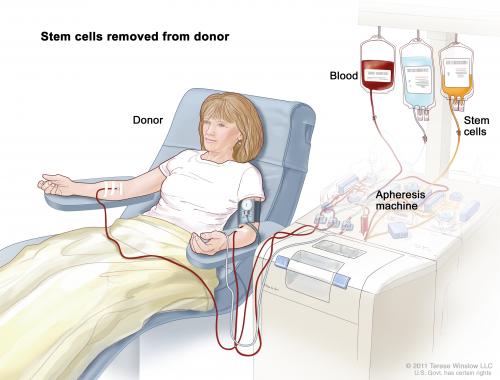
On the 6th day patient is asked to complete a simple and non damaging procedure of stem cell extraction. During the process, a blood separator extracts the stem cell sample. The other blood components return into the blood stream unmodified.
Transplantation
Transplantation (transfer of SC) is a safe, and usually painless procedure. It should be conducted in a sterile environment by a professional medical personnel. Usually, an ambulatory procedure. Within a day the patient usually returns to normal life. Ongoing monitoring of the patient is usually carried out on an ‘out-patient’ basis.
Stem Cell properties
In summary Stem Cells :
- Can independently locate destinations in the body to effect cures,
- Are a universal regulator of all body processes - they are able to restore the original properties of other cells and tissues and slow down pathological symptoms (inflammations, allergies, oncology disorders, etc. )
- Can synthesis bioactive materials needed by the body (growth factors, cytokines)
- Are accepted by the body as their own thus not rejected by the immune system and have no need for special allocation and selection
- Are physically safe for the patient
- Normalize and stimulate regeneration processes
- Normalize the activity of immune and nervous systems
- Successfully reduce all inflammation processes
- Have the potential rejuvenate the body and prevent ageing
- Can cure multiple illnesses and disorders
For more information regarding the use of stem cells in Russia, possible treatment protocols and medical professionals who work with this technology please contact general@stemcells.ru
For biotech and medical equipment companies, who wish to explore the possibilities in Russia, or receive a comprehensive and up to date information about SC research in Russia – please also contact general@stemcells.ru
Thank you for visiting www.stemcells.ru